
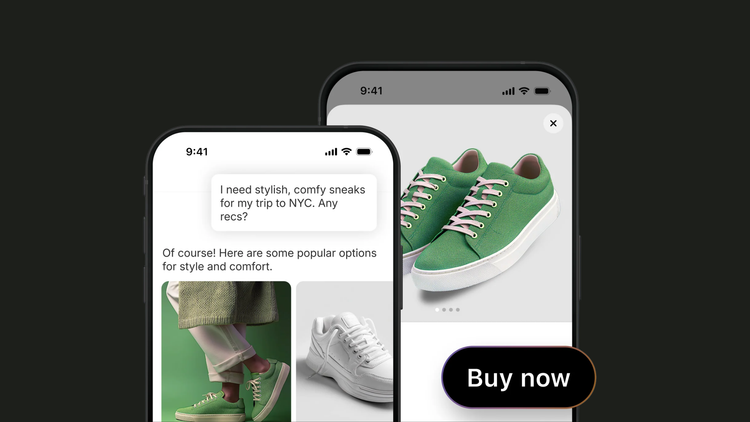
Someone opens ChatGPT and types: "What's the best vegan protein supplement for post-workout?" In seconds, the AI responds with a selection of products, prices, and images. The user clicks and buys, without leaving the conversation.
That's already happening. And if your store is on Shopify, your products may already be appearing there.
Since January 2025, AI-driven traffic to Shopify stores has grown 8 times year-over-year, and orders originating from AI searches have increased 15 times. It's not a future trend; it's the fastest-growing channel right now.
What are Shopify Agentic Storefronts?
Shopify Agentic Storefronts allow customers to discover and purchase products on AI channels, such as ChatGPT, Google AI Mode, Gemini, and Microsoft Copilot. Agentic storefronts are active by default for eligible stores.
In practical terms: Shopify connects your product catalog with the world's leading AI assistants, and those assistants can recommend your products when a user asks a shopping question. It's not advertising. It's not an ad. It's organic discovery within a conversation.
As of March 24, 2026, every eligible Shopify store will be automatically discoverable by ChatGPT's 880 million monthly active users through Agentic Storefronts. There is no app to install or opt-in required.
Channels available today
Shopify merchants are now discoverable on ChatGPT, Microsoft Copilot, AI Mode in Google Search, and the Gemini app, reaching shoppers within conversations where they are already asking for recommendations.
Each channel works differently:
ChatGPT
ChatGPT acts as a referral platform focused on discovery. Users complete their purchase at your online store's checkout, either in an in-app browser on ChatGPT or in a new tab when using the web version. Merchants pay OpenAI a 4% commission on sales generated through this channel.
Google AI Mode and Gemini
Native purchases on Google are progressively being enabled, meaning Shopify merchants will be able to sell directly in AI Mode on Google Search and in the Gemini app. Google AI Mode does not charge additional commissions. This channel is currently in early access and is not available to all stores.
Microsoft Copilot
If you have direct purchase enabled for this channel, customers can complete their purchases at the Shopify checkout integrated into Copilot without having to leave their conversation.

How your products get there: Shopify Catalog
The bridge between your store and all these channels is the Shopify Catalog.
Instead of merchants having to send product feeds directly to each AI platform individually, with Catalog, you list once and it automatically syndicates to every current and future AI channel, including ChatGPT, Microsoft Copilot, and the Shop App. There are no apps to install, no custom integrations, and no transaction fees beyond standard processing fees.
Shopify Catalog builds on the product information submitted by the merchant. Using machine learning and billions of transaction signals, Catalog infers additional product attributes that make products more "discoverable." A candle listed under "home decor" could be identified as a popular Mother's Day gift based on purchasing patterns, making it more likely to appear when an AI agent receives a gift recommendation query.
What you need to be eligible
Agentic Storefronts require: a store that sells to buyers in the United States, added store policies (Terms of Service), guest checkout enabled (you cannot require customers to log in before purchasing), and acceptance of Shopify's terms for the channel.
An important point for Mexican stores: the requirement is not to be located in the USA, but to sell to buyers in that market. Any merchant in Shopify Catalog selling to buyers in the United States can participate, regardless of where the store is located.
Why your catalog data is the most important thing
The quality of the product feed is the most important lever for AI visibility. AI agents display products based on structured catalog data, not page design.
What AI agents read from your products are metafields, descriptions, categories, structured attributes, and consistency across all those fields. A store with good design but incomplete or contradictory product data has less visibility than a store with simple design but clean and rich data.
Shopify Catalog Mapping is most useful for stores with custom data logic and product grouping, such as metafields, metaobjects, tag prefixes, or separators and delimiters in product titles.
The three areas with the greatest impact on agentic visibility are:
1. Complete product descriptions
A description that says "strawberry flavored vegan protein, 500g" does not tell an AI agent enough to specifically recommend it. A description that includes active ingredients, concrete benefits, who it's for, and when it's used, does.
2. Catalog Mapping for stores with custom data
If product data, such as title, description, and category, are stored in custom fields, you can use Shopify Catalog Mapping to ensure that product data is correctly referenced for agentic storefronts.
3. Knowledge Base for brand context
The Knowledge Base App acts as a repository for brand voice, return policies, and FAQs, specifically for AI consumption. It allows you to manage brand-specific FAQs and policies that are exclusively exposed to AI models, ensuring brand-aligned responses in conversational commerce.

A technical case: how optimization looks in a store with a complex catalog
Stores with simple catalogs and clean data enter the agentic ecosystem with little work. The challenge lies in stores with non-standard product architectures.
A concrete example is that of a supplement brand with product linking, meaning distinct products that visually appear as variants within the same product page, but are technically separate SKUs with their own metafields, URLs, and images. From the user's perspective, it looks like a flavor selector. From Shopify Catalog's perspective, without correct mapping, these are fragmented products that the AI agent cannot interpret as a single coherent entity.
Optimization for this type of store involves several fronts:
Catalog Mapping with Product Linking
The Combined Listings Tool is vital for products with high variant counts. Using custom metafields to aggregate variants ensures agents see a unified, coherent product entity instead of fragmented listings. In the case of product linking, the mapping tells the Catalog how to relate these individual products and present them as a complete offering.
Metafield audit
Before the Catalog starts reading the data, it's necessary to check that there are no duplicate or contradictory fields between similar products. A metafield with ingredient information in a different format between SKUs of the same line can confuse the AI agent when making specific recommendations.
Complete descriptions at scale
For catalogs with hundreds of active products, manually completing enriched descriptions is unfeasible. Workflows exist that combine Shopify's bulk editing tools with AI assistance to standardize and enrich these fields efficiently, without compromising accuracy or brand tone.
Knowledge Base with real FAQs
Through the Knowledge Base App, you can configure the tracking of policies, FAQs, and brand voice so that agents have the correct answers about your brand and your offering in every conversation. In technical categories like supplements, where users ask very specific questions about ingredients, compatibilities, or dietary restrictions, this layer of context determines whether the agent recommends the product or not.
The result of this work is that the brand appears with greater clarity and precision in AI agent responses, with specific recommendations by flavor, format, and need, instead of generic or incomplete appearances.
Limitations to be aware of
Before presenting this as a silver bullet, there are several things that are still unresolved:
- The integrated checkout of Agentic Storefronts is not available outside the United States. As of March 2026, it is in early access in the US. For stores that primarily sell in Mexico, this means that the channel currently works in discovery mode, not direct transaction mode.
- Shopify's agentic storefront for Google AI Mode and Gemini is in early access and is not yet available to all Shopify stores.
- Individual product visibility management is not yet available. Today you cannot decide which specific products appear on AI channels and which do not, beyond what you configure at the Catalog level.
- The Catalog algorithm is not completely transparent. Shopify uses machine learning to infer attributes and determine relevance, which means that changes in product data are not immediately reflected and the results are not completely predictable.
Why it matters to start working on this now
Just as early investment in SEO created lasting advantages in search rankings, merchants with rich and structured product data will have a compounded advantage as AI shopping scales.
Stores that optimize their catalogs today are building an advantage that is difficult to reverse later. The channel is still early, which means that competition to appear in those responses is lower now than in six or twelve months.
At Getmore, we are already working on Agentic optimizations with Shopify Plus clients. If you want to know the state of your catalog and how visible your store is to AI agents, tell us about your case.
Frequently asked questions about Shopify Agentic Storefronts
What is Shopify Agentic and what is it for?
Shopify Agentic Storefronts allow customers to discover and purchase products on AI channels, such as ChatGPT, Google AI Mode, Gemini, and Microsoft Copilot. It is the system that connects your Shopify catalog with the most used AI assistants in the world, so that your products appear when someone asks AI for a shopping recommendation.
Do I need to install anything to activate Agentic Storefronts?
No. There is no app to install or opt-in process required. Products from eligible stores are already automatically available. What does require work is catalog optimization to ensure these products appear with better relevance and accuracy.
Is Shopify Agentic available for stores in Mexico?
Discovery, yes. Any merchant in Shopify Catalog selling to buyers in the United States can participate, regardless of where the store is located. Direct checkout within the channel is currently limited to early access in the US, but discovery traffic to your store already works for any location.
How much does it cost to appear on ChatGPT or Copilot?
With Catalog, a merchant lists once and automatically syndicates to all AI channels, with no transaction fees beyond standard processing fees. For sales specifically generated by ChatGPT, OpenAI charges a 4% commission. Google AI Mode does not charge additional commissions.
What is Shopify Catalog Mapping and when do I need it?
Shopify Catalog Mapping allows you to manage how your products are represented in AI channels. It is most useful when your store uses custom data logic, such as metafields, metaobjects, tag prefixes, or separators in product titles. If your store has standard, well-structured data, you probably don't need additional configuration. If you have custom product structures, such as product linking or complex variants, Catalog Mapping is the step that ensures AI agents correctly read that information.
What is the Shopify Knowledge Base App?
The Knowledge Base App acts as a repository for brand voice, return policies, and FAQs, specifically for consumption by AI models. This is where you configure the responses the AI agent will provide when a user asks about shipping policies, ingredients, warranties, or any brand information relevant to the purchase decision.
Will my products appear in all AI searches?
Not necessarily. Visibility depends on how well-structured and complete your catalog data is. AI agents display products based on structured catalog data, not page design. A product with an incomplete description, empty metafields, or conflicting information is less likely to appear in relevant responses than one with rich and accurate data.
Does Shopify Agentic replace traditional SEO?
No. Even when you opt out of Shopify Catalog access in agentic storefronts, your products can still be found in AI channels in the same way they are listed in traditional search engines like Google. SEO remains relevant because it feeds the same database that many AI agents use. The difference is that Shopify Catalog adds a layer of structured data that goes beyond what traditional SEO can communicate.
Interested in reading more about the Shopify ecosystem?
- What is a Shopify Partner and how to choose the right one for your store?
- Ecommerce Trends 2026
- Email Marketing for E-commerce
Note on sources: All content in this post is based on official Shopify documentation: the Help Center, the Shopify Changelog, the official Shopify blog, and announcements from the Winter '26 Edition.
Traffic and order growth figures are data reported directly by Shopify. For updated information on regional availability, please consult the Shopify Help Center directly.
