
E-commerce isn't changing because of trends or new "fashionable" tools. It's changing because people are buying differently.
Today, users expect faster, clearer, and more personalized e-commerce experiences. They want to find what they're looking for effortlessly, pay seamlessly, and feel that the brand understands who they are and what they need.
The e-commerce trends for 2026 are not about doing more things, but about doing the right things better, and what better way to do that than with a Shopify Expert by your side.
Below, we share the trends that, as Shopify Premier Partners in Mexico , we see are already influencing how the best-converting brands sell.
1. Artificial Intelligence as a natural part of the brand experience
Artificial intelligence ceases to be something "visible" or eye-catching and becomes part of the background of the experience.
In 2026, AI will not be about generic chats or automated messages, but about:
-
Recommendations that actually make sense and are based on data.
-
Most relevant search results.
-
Contextual help for making purchasing decisions.
When implemented correctly, the user doesn't think, "This is AI." They simply feel the store is easier to use. Try NEED to test their smart chat.

2. 360° Personalization of the Experience
Personalization is no longer limited to email marketing.
Now it encompasses the entire experience:
-
What the user sees upon entering the store.
-
The offers that are shown to you.
-
The messages you receive before, during, and after buying.
Two people can enter the same store and have completely different experiences, based on their behavior, history, and context. This isn't just "pretty" personalization; it's personalization that helps you sell better.
2.1. “Create your own bundle”: customization that increases the average ticket
More and more brands are moving away from fixed bundles to offer experiences where the customer builds their own kit: choosing products, quantities, and even unlockable benefits as they add more.
As Shopify Experts, our top recommendation for this functionality is the Bundle Builder Rebuy, just as we implemented it in Spring Air .
This type of customization:
-
Improve the shopping experience.
-
Increases AOV (average ticket price).
-
And it can be integrated with tiered discount rules to make it more attractive.

3. E-commerce with a mobile-first approach
Saying a store is “responsive” is no longer enough. By 2026, mobile will be the primary channel.
-
Most of the traffic comes from cell phones.
-
Most purchases are decided there, even if they are finalized on another device.
This implies:
-
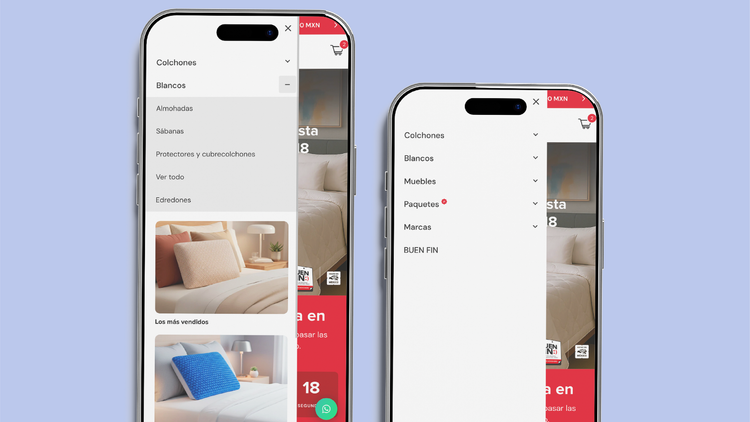
Custom menus on mobile. Today, it's seen as the second homepage of your mobile e-commerce site.
-
Intuitive navigation.
-
Clear CTAs.
-
Fast charging.
If the mobile experience is confusing or slow, the sale is lost before the user even sees the offer. You can take Nook & Scent as a reference.

4. Flexible checkout and frictionless payment methods
The checkout process remains one of the most critical points in e-commerce.
Users expect:
-
To be able to pay however they want.
-
Do not fill out unnecessary forms.
-
Clearly see costs, times and conditions.
Options like BNPL (Buy Now, Pay Later), digital wallets, and local payment methods are no longer an "extra," but a basic expectation.
The less the user has to think about paying, the more likely they are to complete the purchase, and therefore the more your conversion rate increases.
Shopify Plus offers the ability to add "extensions" to the checkout process, allowing you to implement trust symbols such as warranty information, testimonials, reviews, and more. However, there are always workarounds for brands that aren't on the Plus plan. Contact us if you'd like us to help you evaluate your specific situation.

5. True omnichannel (not just being everywhere)
Omnichannel isn't about having separate social media accounts, online stores, and WhatsApp. It's about making sure everything is connected.
The customer expects:
-
Continuity between channels.
-
Let the information travel with him.
-
That the experience is consistent, no matter where you interact.
It's not about adding channels, but about removing friction between them.

6. Subscription models with greater benefits
More and more brands are seeking stability, not just sales peaks. That's why subscription models are evolving:
-
More flexible.
-
More personalized.
-
More focused on reducing cancellations.
Well-designed subscriptions allow you to:
-
Better planning.
-
Higher value per customer.
-
Long-term relationship with the brand.
Check out how Birdman implements this attractive subscription model for its users, offering benefits along the way.

7. Live selling and social commerce
Social networks are no longer just channels for discovery.
Today:
-
Content sells.
-
Creators build trust.
-
Live shopping accelerates purchasing decisions.
Purchasing is becoming more immediate, more social, and less rational. Brands that understand this rely not only on their physical store, but also on how they connect with their audience.
Conclusion
E-commerce trends for 2026 are neither futuristic nor unattainable.
They talk about:
-
Clearer experiences.
-
Less friction.
-
More personalization.
-
Better use of existing technology.
The brands that start applying these trends today are the ones that will sell more tomorrow, not because they follow fads, but because they understand their customers better.
At Getmore , as a Shopify Expert agency in Mexico, we work on these strategies every day with brands that seek to grow sustainably on Shopify.
If you want to prepare your store for what's coming, now is a great time to start. Contact us and we'll help you analyze your e-commerce site.
