
The global dietary supplement market crossed $192 billion in 2024. But the brands winning the largest slice of that market aren't the ones with the biggest marketing budgets or the most SKUs.
They're the ones that built their business on a subscription-first, DTC-native architecture — on Shopify Plus — with obsessive retention mechanics, radical ingredient transparency, and conversion-optimized storefronts that turn first-time buyers into lifetime customers.
We analyzed the top 10 DTC supplement brands running on Shopify Plus globally. Revenue figures, growth trajectories, platform strategies, and the one repeating pattern that separates the $10M brands from the $100M brands. Let's get into it.
At a Glance: The Top 10

The Brands: Deep Dives
1. AG1 (Athletic Greens)


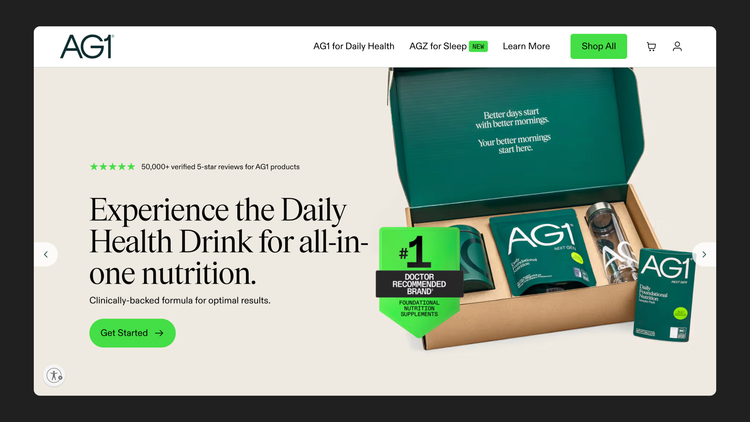
AG1 is the clearest proof that SKU focus beats SKU volume. One product. One daily ritual. $600 million in annual revenue. The brand migrated to Shopify Plus in 2017 and built its entire engine around a single subscription: $79/month, delivered every 30 days.
Their marketing engine runs on podcast dominance — $2.2M per month in podcast ad spend at peak — turning Tim Ferriss, Andrew Huberman, and hundreds of other shows into perpetual distribution machines. The result is a customer who already trusts the product before they ever hit the store.
Don't try to build a product line first. Build one product that converts at 90% subscription rate, then expand. AG1 resisted adding SKUs for years. That discipline is what made them a billion-dollar brand.
2. Bloom Nutrition


Founded by Mari Llewellyn and Gregory LaVecchia, Bloom built the fastest-growing supplement brand in history by doing one thing most brands refuse to do: betting 70-75% of marketing budget on influencer partnerships before they had the revenue to justify it.
They started with greens powders, launched energy drinks that hit $8M in the first 6 months, then prebiotic sodas that cleared $2.7M in their first weeks. Shopify Plus gave them the checkout and subscription infrastructure to handle the volume spikes that come with viral content.
In January 2024, Nutrabolt (the company behind C4 Energy) took a 20% stake at a $250M valuation, validating the model.
If your target customer is under 35, TikTok isn't optional — it's the distribution channel. Bloom didn't discover influencer marketing. They turned it into a repeatable, budget-heavy system and put the store architecture in place to capture every spike.
3. Ghost Lifestyle


Ghost became the definitive proof that supplements can be a lifestyle brand. Founded in 2016 in Chicago, they built their identity on authentic flavor collaborations — Oreo, Sour Patch Kids, Cinnabon, Swedish Fish — and a transparent, community-first culture that the fitness world had never seen from a supplement brand.
In October 2024, Keurig Dr Pepper acquired a 60% stake in Ghost for $990M, implying a total enterprise value of ~$1.65 billion. Their net sales quadrupled in 3 years. KDP purchased primarily for Ghost Energy (the RTD can), but the supplement arm — Ghost Lifestyle — runs independently on Shopify Plus.
Note: Post-acquisition, Ghost is no longer an independent DTC brand. This entry reflects their pre-acquisition model as a benchmark for supplement brand exits.
4. Ritual


Ritual was founded on a counterintuitive premise: "Built for skeptics, by skeptics." Founder Katerina Markov Schneider bet that customers would pay a premium for a vitamin that explained exactly where every ingredient came from — with no proprietary blends, no hidden fillers.
The result is a subscription vitamin brand that has crossed $100M in recurring revenue with a product line that started with a single women's multivitamin and expanded to prenatal, protein, and probiotics — all with the same traceable-ingredient framework. Their Shopify Plus store is designed to educate before it converts.
The Lesson
Transparency isn't just a moral stance — it's a conversion strategy. Ritual's ingredient sourcing maps and third-party testing do more for conversion than any discount ever could. On Shopify Plus, every product page is built to answer the skeptic's objections before they become bounce points.
5. Momentous


Momentous cracked something most supplement brands haven't: using B2B as a credibility engine for DTC. 200+ professional and collegiate sports teams. Department of Defense contracts. NSF Certified for Sport. Informed Sport certified. Scientific advisors including Dr. Andrew Huberman and Dr. Andy Galpin.
Every B2B partnership is proof that their products work at elite levels — and that proof converts consumer customers at a dramatically lower CAC than paid ads alone. Their Shopify Plus store leans hard on this credibility stack.
The Lesson
Third-party validation — certifications, institutional clients, named scientific advisors — doesn't just support conversion. It fundamentally lowers the cost of customer acquisition. Build the credibility stack first, then let your store amplify it.
6. Kaged


Kaged was named Breakout Brand of the Year in the 2023 PricePlow Supplement Industry Awards — and the numbers back it up. A jump from $30M to over $70M in a single year, driven by their Elite Series partnership with GNC (27 new SKUs) and rapid retail expansion into Wegmans, Gold's Gym, and H-E-B.
Their differentiation: clinically dosed formulas — every ingredient at the dosage actually supported by research, not "fairy-dusted" with marketing amounts. NSF Certified and Informed Sport, running a DTC + retail omnichannel model on Shopify Plus.
Retail and DTC are not opposites — they're amplifiers. Kaged used retail shelf presence as a credibility signal that drove DTC search and subscription signups. Your Shopify Plus store is the most profitable channel; retail makes it more discoverable.
7. Transparent Labs


Transparent Labs is the ultimate proof of what happens when you never give up margin to retail or equity to investors. 100% DTC on Shopify Plus. No wholesale. No retail distribution. No proprietary blends — every formula is 100% disclosed, with every ingredient dosed at clinically researched levels.
Their customer acquisition is primarily organic search, community (Reddit, fitness forums), and word-of-mouth. The absence of retail overhead means they can price competitively while maintaining the margins that let them invest in product quality. The flywheel is self-sustaining.
The DTC model's biggest unlock is margin control. Transparent Labs doesn't share 30-50% with a retailer on any sale. That margin either goes back to product quality or to customer acquisition — both of which compound. Shopify Plus is the infrastructure that makes this possible at scale.
8. Obvi


Obvi (co-founded by Ron Shah and Ash Melwani) built their business on a simple, underserved insight: collagen supplements didn't have to taste terrible or look clinical. Flavored collagen protein powders, fat burners with premium ingredients like GreenSelect Phytosome, and a brand identity built entirely around a community of women.
Their Facebook Groups strategy — building an owned community before scaling paid acquisition — is one of the most-studied examples of community-led growth in the DTC supplement space. Products have been used 25M+ times in under 2 years.
Community is not a marketing tactic — it's a retention mechanic. When your customers feel like they belong to something, churn drops dramatically. Obvi built the community first, then built Shopify Plus workflows to activate and monetize it.
9. Green


Grüns is the most exciting rising brand on this list. Starting from a gummy format that makes supplementation genuinely enjoyable, they hit nine-figure revenue territory in their Series A phase. Lifestyle branding, preventive healthcare messaging, and a store experience on Shopify Plus that converts the "I know I should supplement but I don't" consumer.
Format innovation is a positioning lever. Grüns didn't win on ingredients — they won on consumption experience. If your supplement tastes good and feels like a treat, subscription churn approaches zero.
10. Four Sigmatic


Four Sigmatic is on this list as an honest counterbalance. Founded in 2012 in Finland by Tero Isokauppila, they pioneered the functional mushroom coffee category — chaga, cordyceps, lion's mane — and hit $61M in revenue in 2019. Today, their DTC revenue is approximately $14M, a 77% decline from peak.
The category they created got saturated by better-funded competitors. Their single-differentiator positioning — mushroom coffee — wasn't defensible enough when dozens of brands launched similar products at lower price points.
The Lesson
Category creation is powerful — but not sufficient. Four Sigmatic created the mushroom supplement category and couldn't defend it. The brands that survive long-term build defensibility through subscription retention, community, and a brand identity that transcends any single ingredient trend.
The 6 Patterns Behind Every $100M Supplement Brand
After analyzing all 10 brands, 6 patterns repeat across every brand that scaled past $50M. These aren't tactics — they're structural decisions that compound over time.
60–90% of revenue per subscription
3 to 5 core SKUs maximum
100% transparency as a strategy
Shopify Plus as a base
DTC first, retail later
50–70% gross margin
What This Means for Your Brand
The gap between a $2M supplement brand and a $20M supplement brand isn't product quality or even marketing spend. In almost every case, it comes down to three things:
1. Subscription architecture that actually works. Most Shopify supplement stores have a "subscribe and save" checkbox that nobody uses. The top brands engineer their entire purchase flow around subscription conversion — pricing, messaging, checkout experience, post-purchase flows, and retention mechanics. If your subscription rate is below 40%, your store is underperforming.
2. A checkout experience built to increase AOV. The brands generating $100M+ have checkout flows that convert 3-5% higher than the industry average through Checkout Extensibility — upsells, bundles, and cross-sells that feel native, not pushy. This single lever can add $15–$30 to your average order value without changing a single product.
3. A mobile-first, speed-optimized store. 70%+ of supplement purchases happen on mobile. If your Core Web Vitals score is below 80, you are paying a conversion penalty every single day. The top Shopify Plus brands treat page speed as a revenue metric.
These aren't abstract insights. They're the specific technical and strategic improvements that the world's top supplement brands have already made — and that most $1M–$5M brands haven't yet.
