
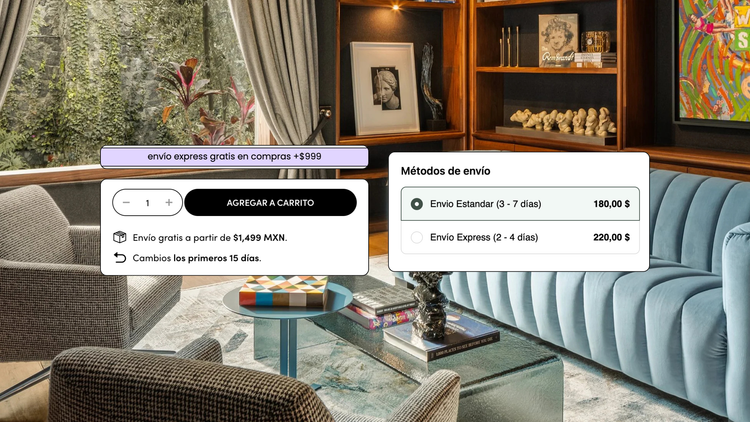
Optimizing conversion in e-commerce doesn't begin with tools or A/B testing. It begins much earlier, with basic decisions that many brands continue to underestimate.
Year after year, the same pattern repeats itself: stores with good traffic, good products, and a clear value proposition, but with friction at the most sensitive points of the purchase journey. And when that happens, no amount of advanced optimization can compensate for what wasn't properly resolved from the start.
Shipping is one of those points. Not because it's the only thing that matters, but because it often influences the final purchase decision more than we think.
As Shopify Experts agency, we will share our analysis on this topic below: Talking about shipping optimization isn't just about logistics. It's about experience, perception, and trust.
Why mailings influence conversion (and why they aren't always analyzed that way)
In e-commerce, shipping is usually analyzed from an operational perspective : costs, carriers , delivery times. However, for the customer, shipping is part of the shopping experience long before reaching checkout.
In practice, the shipment accompanies the entire journey:
-
On the product page , it creates an expectation.
-
In the shopping cart, it influences the perception of value.
-
At checkout, you can influence the final decision.
Many stores lose conversions not because the product is unattractive, but because shipping adds friction at the worst possible time: costs that appear late, unclear conditions, or many options that are difficult to compare.
However, optimizing shipping doesn't necessarily mean charging less. In many cases, it's more about reducing the surprise than lowering the cost. A shipping cost can be acceptable if it's clearly communicated from the start, while a lower cost can lead to order abandonment if it appears unexpectedly.
It's also important to consider that not all customers react the same way. Some prioritize speed, others look for the best price, and still others simply need certainty about when their order will arrive. Therefore, what works for one store or category doesn't always work for another.
Rather than imposing a single rule, optimizing deliveries involves observing how users behave at each stage of the funnel and adjusting the experience to be clear, predictable, and consistent with the brand's value proposition.

Shipping and revenue : when one decision can help you sell more
When discussing optimizing shipments, the idea of free shipping often comes up as an immediate solution. In some contexts it can work, but it doesn't always generate the desired impact.
In some stores, eliminating shipping costs encourages customers to add another item and increases the average order value. In others, offering free shipping without a clear strategy ends up impacting profit margins without actually changing purchasing behavior.
The difference often lies in the context. For example, setting a free shipping threshold can be effective when it aligns with the store's actual average order value. If the amount is unattainable, the incentive is ignored; if it's too low, it loses its value proposition.
There are also scenarios where keeping shipping costs visible, but clear and well-communicated, works better than hiding or subsidizing them entirely. This is especially true when the brand explains delivery times, processes, and expectations from the outset.
Rather than simply copying a formula, the key lies in observing how users respond: whether the average order value changes, whether abandonment decreases, or whether the perceived experience improves. From there, shipping ceases to be seen as an isolated expense and becomes part of a broader revenue strategy.
What data to review before changing your shipping strategy
Before adjusting shipping costs, times, or benefits, it's important to review what's actually happening in the store. Not to find a perfect solution, but to understand where friction is occurring .
Some basic indicators usually give clear signals:
-
Average Ticket Value (AOV): helps define whether a free shipping threshold is realistic or merely decorative.
-
Cart abandonment and checkout: allows you to identify at what exact point the user stops.
-
Geographic distribution of orders: often a small part of the regions concentrates most of the revenue.
-
Most commonly used shipping methods: having many options doesn't always improve the experience.
This data isn't meant to tell you "what to do," but rather what's worth questioning. In some cases, the problem lies in the cost; in others, in communication. And in many more, it's in the lack of clarity regarding timelines, conditions, or expectations.
Reviewing this information allows for more informed decisions and avoids reactive adjustments that don't always address the root cause of the problem.

General best practices for optimizing shipments in e-commerce
Beyond specific rules, there are practices that in most cases help reduce friction and improve the shopping experience when it comes to shipping methods.
-
Clarity from the start: Showing costs, estimated times and shipping conditions in the early stages of the journey avoids surprises at checkout and helps the user make decisions with greater confidence.
-
Fewer options, better experience: Offering too many shipping methods doesn't always improve conversion; in many cases, it creates indecision. Fewer options, well explained, usually work better than a wide range without context.
-
Consistency with the value proposition: shipping should feel aligned with the brand. Timing, costs, and communication must make sense in relation to the type of product and the promised experience. Not all stores need to be the fastest, but they do need to be predictable.
Finally, it's important to understand that optimizing shipments isn't a one-time adjustment. As volumes, markets, or customer behavior change, the strategy may also need adjusting. The key is to review, learn, and adapt, not to search for a "definitive" configuration.
Conclusion
Optimizing shipping in e-commerce isn't about applying a one-size-fits-all formula or copying what works in another store. It's about understanding how shipping impacts the customer experience and how that experience influences conversion and sales.
Brands that intentionally address this issue don't necessarily offer free shipping or aggressively cut costs. Rather, they make informed decisions, aligned with their context and their customers' expectations.
If at any point you want to review how this part of your store is performing and analyze which adjustments could have the greatest impact, that process begins with observation, not assumptions. Contact us , and we'll gladly help you analyze your specific case as an expert Shopify agency.
