
For years, if you wanted to sell wholesale with Shopify's native tools, the answer was always the same: you need Plus. That has changed.
Shopify's core B2B features are now available on Basic, Grow, and Advanced at no additional platform charge. This is a major shift for brands selling both directly to consumers and to distributors, resellers, or other businesses—including wholesale businesses in the United States.
At Getmore, we have spent more than 10 years building Shopify stores in Mexico. As a Shopify Premier Partner, we have implemented B2B for brands ranging from manufacturers to regional distributors. Here is what you need to know to put these tools to work for your business.
What exactly changed?
Shopify has opened native B2B features previously exclusive to Shopify Plus to merchants on standard plans. Here is the breakdown:
What you can do on Basic, Grow, and Advanced
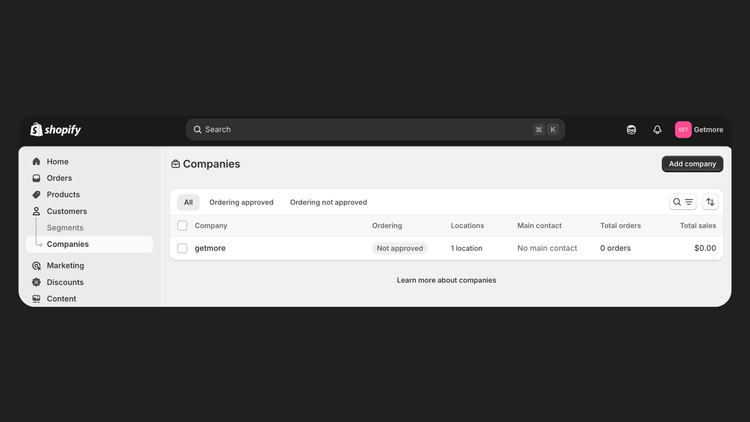
Company profiles: Create a profile for each B2B customer with their contacts, shipping locations, and payment terms. Connect buyers to the appropriate B2B market and catalog pricing. You no longer need third-party apps or customer-tag workarounds for these core wholesale functions.
Up to 3 active catalogs through Markets: Offer different products, prices, and discounts to different buyer segments. One catalog can include your full product line; another can contain wholesale SKUs at distributor prices. The limit is three active catalog assignments across all B2B markets, and these features require the new Shopify Markets.
Volume pricing and quantity rules: Set unit prices based on purchase volume—for example, one price for 5–9 units, another for 10–49, and a third for 50 or more. Set minimums, maximums, and increments for product variants. For basic wholesale requirements, this can replace separate volume-discount apps.
Payment terms: Assign terms such as Net 15, Net 30, or Net 60 to company locations. Authorized buyers can place orders using their agreed terms instead of paying the full balance immediately. That brings your online ordering process closer to the way your wholesale customers already buy.
Vaulted credit cards: Securely save eligible B2B customers' cards through Shopify Payments to simplify future payments. This is useful for distributors placing repeat orders every week or month.
ACH payments in the United States: Eligible US stores using Shopify Payments can offer ACH Direct Debit to B2B customers. This gives wholesale buyers a bank-payment option alongside eligible card payments.
What is still exclusive to Shopify Plus?
Shopify has not opened every feature to every plan. More complex wholesale operations still benefit from capabilities reserved for Plus:
- Unlimited B2B catalogs — If your native setup needs more than three active B2B market catalog assignments—for example, separate pricing for regional distributors, national distributors, and export accounts—Plus removes that limit.
- Direct catalog assignment to companies and locations — On non-Plus plans, catalogs are assigned through B2B markets. Plus also supports direct assignment to specific companies and company locations for customer-level pricing.
- Partial payments and deposits — Required deposits, partial payments, and payment requests per fulfillment remain Plus features.
- Advanced checkout customization — Plus unlocks deeper customization of the checkout information, shipping, and payment steps. Basic B2B capabilities such as purchase order numbers are already available on all plans; more tailored buying experiences need a scope matched to your operation.
Why this matters for US wholesale businesses
If your wholesale operation still depends on PDF price lists, orders sent by email, and payments reconciled manually, your team is doing work that a buying portal could handle. That friction costs time and makes it harder for distributors to reorder.
Opening native Shopify B2B to standard plans lets you digitize that operation without committing to a Plus subscription. In the United States, Shopify Plus starts at US$2,300 per month on a three-year term or US$2,500 per month on a one-year term. For a growing wholesale business that does not yet need Plus, this creates a practical way to start.
A typical use case:
A brand sells DTC through its Shopify store and also supplies 20–50 distributors who receive price lists by email. With native B2B on Grow or Advanced, that brand can:
- Create a company profile for each distributor
- Offer pricing through its B2B market catalogs, within the three-active-catalog limit on non-Plus plans
- Set payment terms such as Net 30
- Give buyers access to a self-service ordering portal
The brand can keep DTC and B2B in the same store, with no separate wholesale app required for these basic use cases. The setup still needs to match the way the business sells and fulfills orders.

Native B2B or third-party apps: which should you choose?
Before this change, common options for Shopify B2B without Plus included apps such as Wholesale Club, Wholesale Gorilla, and SparkLayer. Third-party tools can still be the right fit, but the starting point for the decision has changed.
Use native B2B if:
- Your wholesale pricing fits within three active B2B market catalogs
- You do not need complex order-approval workflows
- You want a closely integrated setup with fewer separate systems to maintain
- You are evaluating whether wholesale volume justifies a future upgrade to Plus
Consider third-party apps if:
- You need specialized workflows, such as multi-step order approvals, custom portals, or connections to a proprietary ERP
- Your pricing requirements go beyond what three native catalogs can support
- You need a quote-to-order workflow
Consider Shopify Plus if:
- You need more than three active native B2B market catalogs or direct company-level catalog assignment
- You need advanced checkout customization for wholesale buyers
- Your B2B order volume supports the investment in an enterprise platform
- You need Plus-specific automation capabilities; Shopify Flow itself is also available on Basic, Grow, and Advanced
How to set up Shopify B2B, step by step
If you are on Basic, Grow, or Advanced, you can start configuring native B2B in Shopify admin. Catalog features on these plans require the new Shopify Markets. Here is the setup process:
Step 1: Open Companies — In Shopify admin, go to Customers → Companies. Confirm that your account has the permissions needed to manage B2B customers.
Step 2: Create your catalogs — Open Catalogs in Shopify admin and create a catalog. Choose the products and set pricing adjustments, fixed prices, or volume price breaks as needed.
Step 3: Set up B2B markets — On non-Plus plans, catalogs are assigned through Shopify Markets. Create the B2B markets your operation needs and assign catalogs within the three-active-catalog limit.
Step 4: Create company profiles — Go to Customers → Companies → Add company. Add contacts, locations, and payment terms. On Basic, Grow, and Advanced, catalog pricing is assigned through B2B markets; direct company and location catalog assignments require Plus.
Step 5: Give buyers access — Add buyers as company contacts and send them access to the store. When they sign in through customer accounts with the email linked to their company, they can access the products, pricing, and terms assigned to them.

Shopify B2B FAQs for US businesses
Can I run DTC and B2B in the same Shopify store? Yes. A blended Shopify store supports both. Visitors see your DTC storefront, while signed-in company buyers can access the B2B products, pricing, and payment terms assigned to them. Getmore helps you plan that experience around how your retail and wholesale customers buy.
Does Shopify B2B work with Shopify Payments in the United States? Yes, for eligible US businesses. Shopify Payments supports vaulted B2B credit cards, and eligible stores can also offer ACH Direct Debit. Getmore can help you configure the buying and payment experience to match your wholesale terms.
What if I need more than three active B2B catalogs? Shopify Plus supports unlimited B2B market catalogs and direct company-level catalog assignments. A third-party pricing solution may also fit your requirements. At Getmore, we compare both routes against your order volume, pricing rules, and operating costs so you invest in the right setup.
Can Shopify B2B connect to my ERP? Shopify provides APIs for companies, catalogs, and other B2B data. Connecting systems such as SAP or Odoo is possible, but the work depends on your ERP and the data you need to sync. Getmore can scope the integration around your products, inventory, customer pricing, and orders.
Is there a limit to the number of companies I can create? The three-catalog limit on non-Plus plans is not a three-company limit. Shopify does not list a company-profile cap in its B2B plan comparison. The relevant constraint for standard plans is the number of active B2B market catalog assignments.
Now is the time to build your wholesale channel
Shopify has significantly lowered the barrier to native B2B ecommerce. If you already sell wholesale—even on a small scale—and use Shopify, you have a practical opportunity to replace emailed orders and PDF price lists with a buying experience that makes reordering easier.
Whether you are exploring native B2B, need more than three catalogs, or require a more complex implementation, we can help you choose the right path and turn it into a working wholesale operation.
Getmore is a Shopify Premier Partner based in Mexico. We have implemented B2B for manufacturing, distribution, and retail businesses. We understand the use cases, the platform's limits, and how to build a solution around them.
