
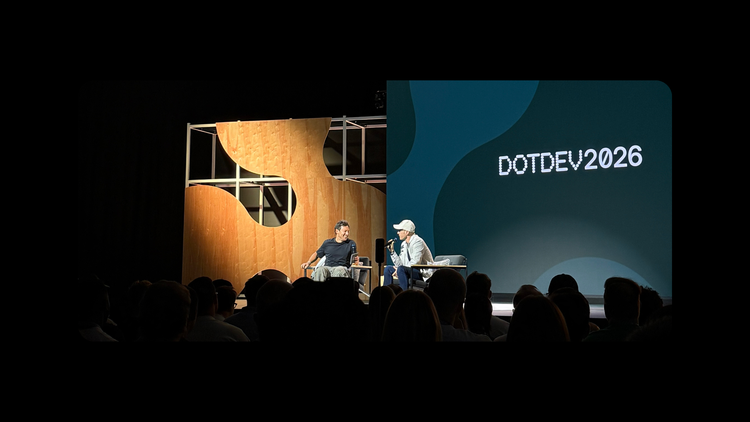
On July 21–22, 2026, Shopify brought its developer and partner community to Toronto for DotDev. Getmore attended the two-day event alongside agencies, developers, and technology partners from around the world.
DotDev goes beyond a marketing keynote. It gives the technical community a closer look at Shopify's direction through presentations, demos, and conversations with the teams building the platform.
What we saw reinforced an important point for merchants: changes in the Shopify ecosystem are affecting both how stores operate and how customers discover products.
These are our main takeaways, with a distinction between announcements, capabilities available to eligible stores, and features still rolling out.
Sidekick: Shopify's AI assistant is operating at scale
The Sidekick adoption figures shared during DotDev showed how quickly merchants were putting the assistant to work.
According to the figures presented at the event and recorded in Getmore's recap, merchants had used Sidekick over 18 months to create 32 million analytics reports, 25 million theme edits, 3.4 million customer segments, and 600,000 Flow automations. These figures describe adoption reported during the presentation, not results a particular store should expect.
A major development was Sidekick's ability to work with supported third-party apps. Klaviyo and Judge.me are examples documented by Shopify. Instead of moving between separate interfaces for every task, merchants can ask Sidekick to perform supported actions after approving app access. Available actions depend on the integration and permissions.
Tobi Lütke described the ambition behind Sidekick as helping each merchant in the context of their own business: understanding their situation, what they need, and how to move forward. AI makes that kind of contextual assistance possible at a scale that individual conversations could not reach.
A redesigned collections model
Collections organize how customers discover products: the categories in your menus, the curated ranges they browse, and the groups you build around a need or campaign.
Shopify's new collections model brings together automatic conditions, manually selected products, individual variants, other collections, and supported app sources. It replaces the old choice between manual and smart collections as the new model becomes available in each admin.
The technical change has practical implications for day-to-day merchandising.
Previously, adding a specific product that did not meet a smart collection's rules often required changing the rules, switching approaches, or using a workaround. Some brands duplicated collections or added apps to handle those needs.
The new model allows multiple sources to work together in one collection, combining automated membership with deliberate merchandising decisions.
Collections of specific variants
Fashion and accessories brands can build a collection around selected variants instead of entire products. A red-and-pink campaign, for example, can focus on those colors rather than showing every colorway. Check the new model's availability and the presentation in your sales channels and theme before launching it.
Nested collections
A collection can use other collections as sources. For example, an Activewear collection can combine Leggings, Tops, and Shorts, reflecting changes to the underlying sources without maintaining another manual product list.
Exclusions
The new model supports automatic exclusion conditions and manually excluded products. That gives merchandisers more control over the final assortment without abandoning automated sources.
Using Sidekick for merchandising
The event also demonstrated the direction of natural-language merchandising: asking Sidekick to help create or adjust collections, such as a new-arrivals selection with an age-based rule. Review the resulting conditions and available actions in your own admin before applying them.
Shopify documents collections for Basic and higher plans, but the new model is still being introduced. When available in an admin, previous collections are converted; stores without it continue using the legacy model. Do not treat this as a reason to rename collection URLs. Before adopting new merchandising logic, check product membership, links, theme output, and indexing. An unchanged URL alone does not remove every SEO risk.

Product discovery in ChatGPT, Google, and Copilot
Agentic commerce received significant attention. A presentation by Tamir from 40ty described shifts the company was observing in AI-referred ecommerce traffic.
In the data presented at the event, AI-referred traffic had moved from converting below organic Google traffic to converting 42% better, with value per visit 53% higher. The presentation also cited stronger retention of AI-recommended purchases. These figures belong to that presentation and its sample; they should not be treated as universal conversion or return-rate benchmarks.
The same presentation reported revenue growth from AI channels in 33% of the stores monitored, with 70% quarter-over-quarter growth during the period discussed. Store mix, attribution, and baseline volume matter when interpreting those numbers.
One plausible explanation is intent: a shopper asking an assistant for a specific product can arrive with more defined requirements than someone browsing broad search results. That makes AI referrals worth measuring, but it does not mean every AI visit will outperform every Google visit.
How do products reach AI shopping channels?
Shopify's Agentic Storefronts makes eligible products available to supported AI channels. Shopify Catalog supports product discovery for some channels; Google AI Mode and Gemini use the Google & YouTube channel or Google Merchant Center. Channel eligibility, product requirements, and activation settings still apply. Product availability does not guarantee that an assistant will recommend it.
At DotDev, Tobi emphasized that product discovery requires more than generic information retrieval. Shopping depends on context: who a product is for, what makes it suitable, and when someone needs it. Catalog is designed around commerce-specific data rather than a page of general text.
What can you improve now?
Give product data enough detail to support a useful match. A generic description such as brown shoe, size 8 leaves many questions unanswered. Materials, fit, intended use, care, availability, and genuine differentiators help customers and discovery systems understand the offer. Keep prices, inventory, and policies accurate. Better data supports eligibility and relevance; it is not a promise of placement.
Want to understand whether your Shopify catalog is ready for AI discovery? Talk to Getmore about your store. We can review the product information, storefront experience, and technical setup together.

Inventory changes that matter behind the scenes
The event discussed a double-sided inventory ledger: an approach that accounts for where stock movements come from and where they go. The operational value is traceability—making discrepancies easier to investigate rather than relying on disconnected adjustments.
Another direction discussed was bins, or subdivisions within an inventory location. The use case is separating stock on the retail floor from back-room inventory used for online fulfillment. Treat roadmap concepts as capabilities to verify in your admin before designing an operating process around them.
Mixed fulfillment was another topic: a customer may want some items shipped and others collected within one order. Before promising this journey, confirm the supported checkout, delivery, and pickup configuration for your store, then test the full purchase and fulfillment flow.
River: the AI agent Shopify uses internally
Harley and Tobi also discussed River, Shopify's internal AI agent. It is not a merchant product, but the example illustrated how the company is using AI in its own operations.
According to the presentation, River worked in public Shopify Slack channels with roughly 6,000 employees across more than 4,400 channels over a 30-day period. The team also reported 1,870 code pull requests opened in one week and involvement in about one in eight accepted changes to the main repository. Those are event-reported figures about Shopify's internal work.
For merchants, the relevance is the direction of travel: Shopify is exploring internally the same kind of contextual assistance and tool-connected work it is bringing to merchant workflows.
Three ideas from Tobi worth remembering
Beyond the product announcements, three themes from the stage stood out.
Ambition needs systems that can support it.
Vision alone does not create a reliable operation. Merchants need accurate inventory, organized customer data, and processes that can support growth. AI becomes more useful when that foundation is already in place.
The lesson of Norman doors
Tobi described removing confusing doors from Shopify's offices: doors that suggest pushing when they should be pulled. His point was that a team building intuitive software should recognize friction in its own environment. The ecommerce equivalent is a checkout control or navigation label that makes a customer second-guess what to do.
Entrepreneurs and AI
Tobi argued that entrepreneurs are especially well positioned to benefit from AI: they can access more knowledge and accomplish work faster with smaller teams. His broader view was that disruption can also create new opportunities for people to start businesses.
What agencies learned about delivering work with AI
Several agencies shared how AI is changing their operations. Their experiences matter to both agency owners and merchants evaluating delivery partners.
Overdose, described in the session as a 150-person Asia-Pacific agency, reported doubling execution capacity without cutting complete project timelines in half. Problem definition, client alignment, and decisions remained the constraints even as production accelerated.
The agency's conclusion was that hours had been a way to measure work rather than the value itself. Models under consideration included fixed deliverables, a base fee with a results-linked component, and dedicated teams for a defined period.
The team also reported AI token costs nine times higher than projected—a reminder to include tooling and review costs when evaluating efficiency gains.
Germany's Tante-E emphasized adoption and culture. Its first meeting-transcription rollout struggled because the tool was imposed without explaining the value or addressing team concerns. New software does not remove the need for a clear process and accountable people.

Shopify DotDev 2026 FAQs
What is Shopify DotDev?
DotDev is Shopify's developer and technical-partner event, formerly known as Editions.dev. The 2026 event took place in Toronto on July 21–22. It brings developers, agencies, and partners together for technical sessions, platform announcements, and discussions with Shopify teams.
What is Shopify Sidekick?
Sidekick is Shopify's AI commerce assistant. It helps merchants analyze information, create content, and complete supported admin tasks through natural-language requests. It can also work with compatible installed apps after approval. Some features have specific plan or device requirements, so check the capability you need rather than assuming every Sidekick feature is available everywhere.
How can my products appear in AI shopping recommendations?
Check your store and product eligibility, review your Agentic channel settings, and maintain detailed, accurate product data. Use the required Google product connection for Google AI Mode and Gemini. These steps make products available for discovery; they do not guarantee recommendations. Getmore can audit the catalog and storefront to identify gaps in information, structure, and the buying journey.
What are variant collections in Shopify?
The new collections model can include specific variants, such as selected colors, instead of every variant of a product. That supports more precise merchandising without using duplicate products simply to isolate a color. Confirm that the new model is available in your admin and verify how the collection displays in your theme and sales channels.
What does Shopify Catalog do?
Shopify Catalog organizes commerce data to support product discovery in connected shopping experiences. It is part of the Agentic Storefronts ecosystem, alongside channel-specific requirements. Google discovery uses its own product-data connection. Read more in our Shopify Agentic Storefronts guide.
What is agentic commerce?
It is shopping assisted by AI agents that help people find and evaluate products and, in supported channels, buy them. The checkout experience differs by channel. Shopify's current documentation describes ChatGPT purchases completing through the merchant's online-store checkout, while eligible direct-checkout integrations in other channels can keep the transaction within that channel.
What is Shopify River?
River is the internal AI agent Shopify discussed at DotDev for its own employees. The presentation described work in Slack, data queries, tool use, and code contributions. It is not a merchant app you can install; its relevance is as an example of Shopify's approach to AI-assisted operations.
What should a Shopify merchant prioritize after these announcements?
Start with improvements you can verify and use: accurate product data, supported AI-channel settings, merchandising capabilities available in your admin, and workflows Sidekick can help with today. Evaluate roadmap items separately. Getmore can turn the announcements into a prioritized implementation plan tied to your store's conversion, operations, and growth goals.
Want more practical analysis of the Shopify ecosystem?
- Shopify Editions Spring '26: what changed for your store
- Shopify Agentic Storefronts: product discovery in AI channels
- What is a Shopify Partner, and how can one help?
Technical references, checked October 1, 2026: Shopify collections, Shopify Agentic Storefronts, DotDev 2026.
